USMCA 2.0: Could Tougher Rules Create Unintended Consequences for Automakers?
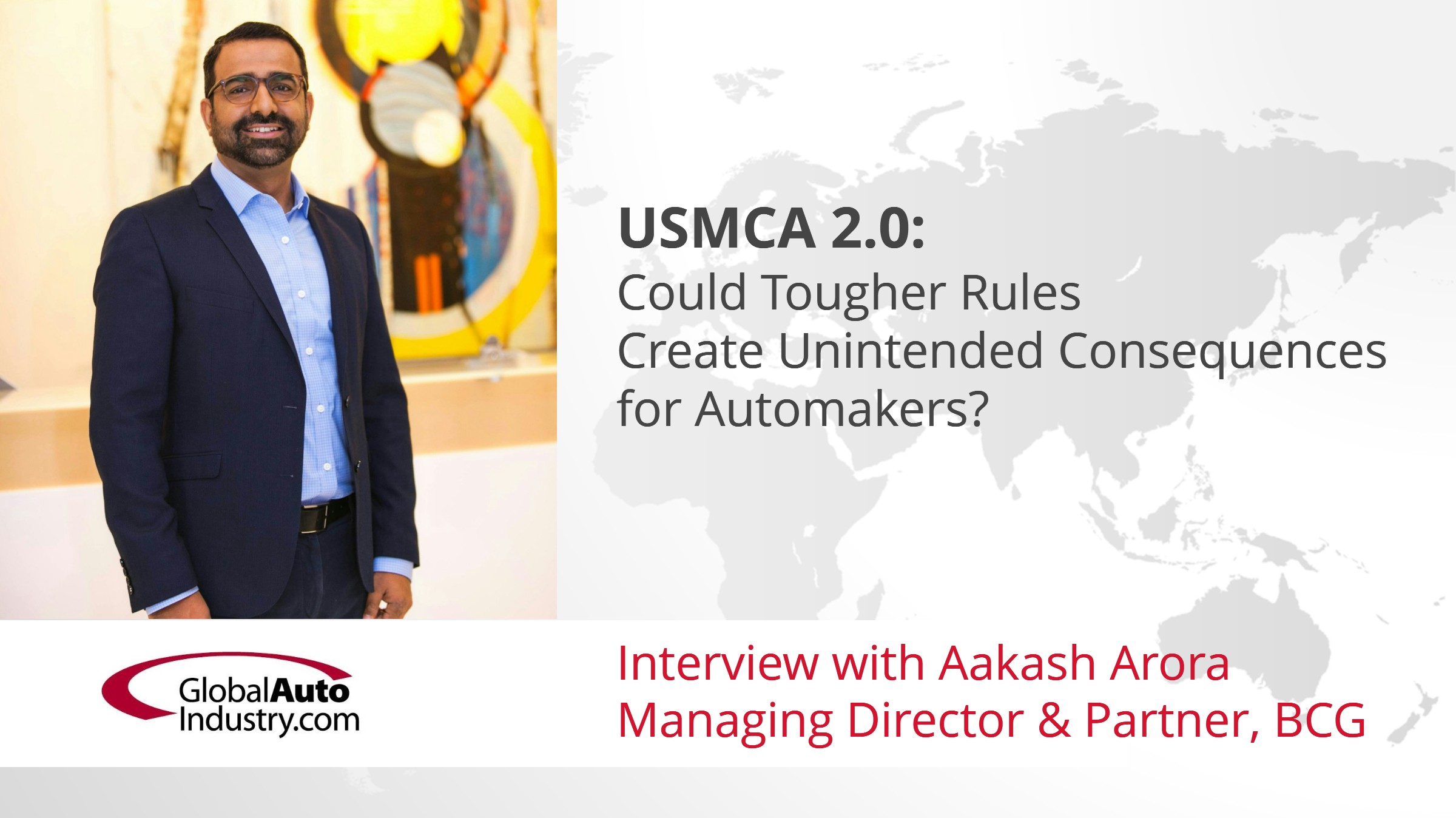
GlobalAutoIndustry.com’s latest Audio Interview “USMCA 2.0: Could Tougher Rules Create Unintended Consequences for Automakers?” with Ron Hesse features Aakash Arora. Aakash is Managing Director and Partner in Boston Consulting Group’s Boston office, and who serves as North America’s Auto and Mobility Sector Leader. Aakash brings 25 years of automotive experience across software-defined vehicles, embedded software, Semiconductors, connectivity and vehicle architecture. Since joining BCG in 2011, he has advised leading OEMs, Tier 1 suppliers, technology players, and private equity clients on transformation, strategy and M&A. Previously, Aakash held software engineering and business strategy roles at Motorola/Continental Automotive.
In the 15-minute Audio Interview, Mr. Arora discusses these questions:
- Aakash, you’ve written that all three potential USMCA negotiation scenarios point toward tougher compliance requirements. What are the most important changes automotive executives should be paying attention to right now, and why?
- One of the most striking findings in your analysis is that many vehicles assembled in Mexico and Canada appear to fall well short of a potential 50% U.S.-content requirement. How significant is that gap, and why would it be so difficult for automakers to close it quickly?
- Conventional wisdom suggests that tougher local-content rules encourage more manufacturing in the United States. Yet your research points to a different possibility. Can you explain the unintended consequence you see emerging and why some OEMs might actually shift production outside North America?
- If USMCA 2.0 moves forward with stricter requirements, what strategic choices will OEMs be weighing over the next 12 to 24 months? What trade-offs should executives be thinking about today?
- Given the uncertainty around the final shape of USMCA 2.0, what actions should automotive executives take now to prepare, regardless of how negotiations ultimately conclude?
Related posts:
 U.S. Supreme Court Rules on Tariffs: What the Global Automotive Industry Needs to Know
  Global Executive Survey: Key Findings of Software-Defined Vehicles
  Trade Deals, New Roads: How EU and U.S. FTAs Could Redefine India’s Auto Future
  Automobility 2.0: Connected, Electric & Intelligent – A China Perspective